The upcoming ebbtide zombie game is shaping up to be one of the most ambitious real-time strategy survival experiences currently in development. If you are tracking the ebbtide zombie game, you know it blends large-scale military command with desperate last stands against relentless undead hordes.
Strategy enthusiasts and survival game fans are always looking for titles that break new ground. Traditional real-time strategy games often rely on isolated missions and hidden auto-resolve mechanics, but this project promises something entirely different. By placing players in control of humanity’s final naval carrier task force and forcing them to manage supplies, logistics, and terrifying undead sieges across a seamless map, developer ProjectAlive is offering a fresh spin on the genre. Let’s dive deep into what makes this title stand out.
The Seamless Operations Map and Core Gameplay Loop
One of the most exciting aspects highlighted on the official Ebbtide Steam Page is the unique approach to the game world. Instead of dividing the campaign into disconnected missions, the title utilizes a continuous, zoomable operations map.
When you scroll into any street on the tactical display, the view transitions instantly into a live battlefield without any loading screens. Zoom back out, and the overarching war continues to run in real-time. According to community reports and developer updates, every lost soldier, fallen zombie, and destroyed building directly impacts the broader strategic landscape.
| Feature | Traditional RTS Approach | Ebbtide Approach |
|---|---|---|
| Mission Structure | Separated levels with loading screens | Seamless, continuous map from city to globe |
| Combat Resolution | Frequently uses automated calculations | Fully simulated real-time engagements |
| Consequences | Limited to current mission objectives | Losses carry over directly to the overarching campaign |
| Pacing | Scripted progression checkpoints | Dynamic pressure scaling based on logistics |
This design philosophy eliminates the safety net of hidden auto-resolve mechanics. If a forward outpost falls, the rest of your supply chain feels the immediate shockwave.
Commanding Los Angeles Under Siege
The campaign kicks off in a beleaguered Los Angeles, stretching from the iconic Hollywood Hills all the way down to the Port of LA. As a player, you command Task Force 1 “Ark.” As districts slide from stability into crisis and eventual collapse, you must make brutal logistical choices.
You cannot save every single block or neighborhood. Managing the crisis requires juggling multiple localized defense and evacuation efforts:
- Local Forces Coordination: Order National Guard detachments, LAPD officers, and LA County Sheriff units to hold strategic bottlenecks, delay advancing hordes, or execute tactical withdrawals.
- Heavy Reinforcements: Call in elite Marines staged out of Camp Pendleton to spearhead counter-offensives.
- Logistics and Convoys: Dispatch truck and helicopter convoys to haul critical supplies, fresh troops, or desperate refugees out of harm’s way.
- Extraction Operations: Pull cut-off units and stranded civilian pockets behind friendly lines before the horde completely surrounds them.
Player experience within community hubs notes that line-of-sight mechanics play a massive role here. Hordes lurking in the fog of war remain hidden until your scouts or patrols visually confirm their positions, adding a terrifying layer of tension to scouting missions.
An Adaptable, Relentless Horde
Fighting the undead in this title is vastly different from typical wave-survival games. The artificial intelligence and physics system governing the horde create dynamic tactical threats.
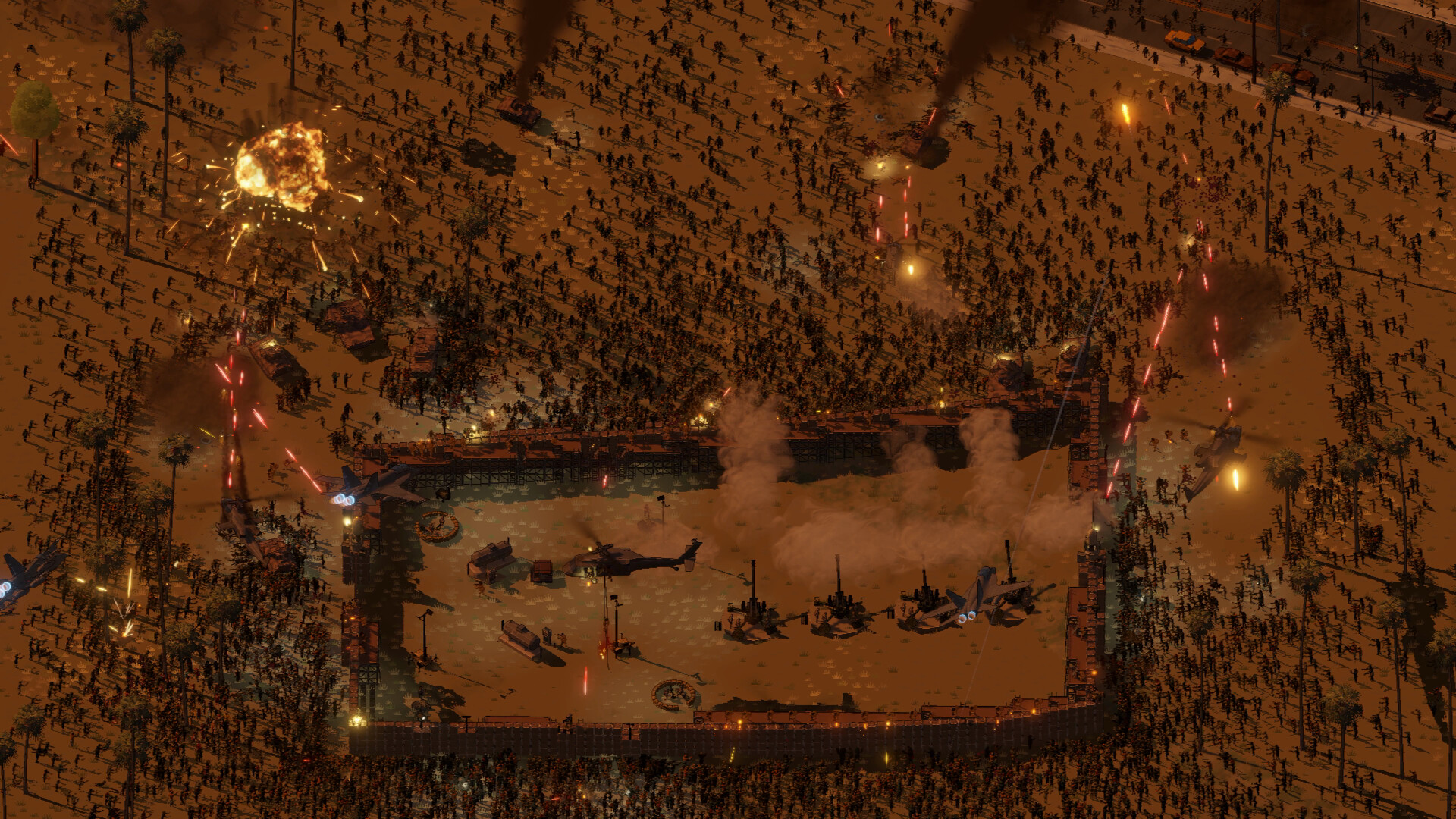
Zombies do not simply trickle in; they pile on top of one another to scale tall defensive walls and building rooftops. Furthermore, they will actively cling to low-hovering helicopters, making extraction and close air support perilous. To make matters worse, any human soldiers cut down by the horde rise again as infected combatants, turning your own casualties into future threats.
| Threat Level | Zombie Behavior | Tactical Countermeasure |
|---|---|---|
| Standard Hordes | Swarm streets and overwhelm linear defenses | Choke points, barbed wire, and sustained machine gun fire |
| Vertical Stack | Pile up to scale walls and multi-story rooftops | Elevated scaffolding, shotgun patrols, and active clearance |
| Air Interference | Cling to hovering aircraft near ground level | Maintain altitude discipline and use armed escort gunships |
| Infected Conversions | Fallen human troops instantly rise as enemies | Immediate recovery of bodies or scorched-earth protocols |
Unleashing Modern Military Firepower
When conventional infantry lines begin to buckle, commanders can bring devastating heavy firepower to bear. The game features an extensive arsenal designed to level city blocks—along with whatever happens to be standing inside them.
- Artillery Support: M777 howitzers and mobile HIMARS rocket systems for long-range barrage capability.
- Naval Bombardment: Destroyer deck guns and precision Tomahawk cruise missiles launched from offshore assets.
- Fixed-Wing Air Power: Carrier-based F/A-18 Hornets, alongside Air Force F-15Es, F-35Bs, and A-10 Thunderbolt II ground-attack runs.
- Loitering Munitions: Continuous fire support from AC-130J Ghostrider gunships and persistent MQ-9 Reaper drone orbits.
While these weapons deliver immense destructive potential, ship magazines are strictly finite. Additionally, using heavy explosives in dense urban environments brings buildings crashing down, altering the layout of the streets forever.
Base Building and Logistics Management
Survival in the ebbtide zombie game is entirely anchored on supply lines. Soldiers, armored vehicles, and aircraft consume massive amounts of ammunition and fuel daily, and they can only rearm and refuel at forward operating bases under your direct control.
Establishing a viable base requires careful site selection. You must raise HESCO barriers and reinforced concrete walls, install defensive gates, and construct scaffolding to give your defenders proper firing angles. Next come the vital support structures:
| Facility Type | Primary Purpose | Resource Requirement |
|---|---|---|
| Gun Nests & CIWS | Automated perimeter defense | Power, Ammunition |
| Mortar Pits | Indirect fire support against approaching hordes | Ammunition, Personnel |
| Ammo Depot & Fuel Point | Restocking mobile units and patrols | Logistics Truck Deliveries |
| Perimeter Lighting | Maintaining visibility during night cycles | Generator Fuel |
Building materials must be physically hauled in by hooklift trucks or sling-loaded by helicopters. Because the horde actively hunts your supply convoys and cuts off roadways, maintaining open supply routes becomes just as important as holding the front lines.
From Los Angeles to a Global Campaign
Once you stabilize the situation at the Port of LA, the scope of the game expands dramatically. The personnel, survivors, equipment, and supplies you managed to salvage form your initial expeditionary force aboard the carrier task force.
From there, the global campaign begins. You must choose which international regions to support, navigate the carrier group into coastal strike range, and establish resupply routes at friendly ports. Along the way, you can rescue specialist engineers and pilots who cannot be easily replaced, integrate allied warships into your fleet, and hunt down the mysterious Nexus’s hidden command nodes across the globe.
Frequently Asked Questions
What is the release date for the ebbtide zombie game?
The developer has currently slated the release window as “Coming soon.” Fans can add the title to their Steam wishlists to receive immediate notifications when playtest opportunities or launch dates are announced.
How does base building work in the ebbtide zombie game?
Players can select strategic locations to construct forward operating bases, erecting HESCO walls, gates, and defensive scaffolding. Keeping these bases functional requires managing continuous supply lines for fuel and ammunition hauled in by trucks or helicopters.
Does the game feature multiplayer or is it strictly single-player?
Current feature listings and documentation confirm that the title is designed as a single-player strategic experience focusing on deep tactical command and resource management.
What platform requirements should players expect?
The game requires a 64-bit processor running Windows 10 or Apple Silicon on macOS, with at least 10 GB of available storage space. Final hardware specifications are scheduled to be finalized closer to release.