When the world faces an unyielding tide of the undead, traditional military tactics quickly fall apart, making the upcoming ebbtide zombie survival RTS one of the most anticipated tactical experiences on the horizon. If you have been searching for a fresh take on large-scale apocalyptic warfare, the ebbtide zombie survival RTS delivers an intense blend of base management, squad commands, and overwhelming horde mechanics that will test every ounce of your tactical thinking.
Understanding the Core Mechanics of Ebbtide
Developed by ProjectAlive, this real-time strategy title drops you directly into a desperate military campaign where humanity makes its final stand. Unlike traditional strategy games that rely on separate, instanced missions and hidden auto-resolve screens, this game treats the entire operational space as a continuous, living theater of war.
When you command TF-1 “Ark”—humanity’s last carrier task force—every decision matters permanently. Scroll into any city street, and the tactical UI transitions instantly into a live battlefield without a single loading screen. Scroll back out, and the overarching war continues to tick forward in real time. Every soldier lost and every building leveled has a lasting impact on your campaign.
| Feature Aspect | Tactical Implementation | Strategic Impact |
|---|---|---|
| Map Transition | Seamless zoom from global to street level | Zero loading screens; continuous battlefield awareness |
| Persistence | No hidden auto-resolve calculations | Every casualty and destroyed structure carries back to the map |
| Visibility System | Limited line of sight for active units | Hordes remain hidden until spotted by your forces |
| Time Controls | Pause, regular speed, or up to 4x fast-forward | Crucial for managing rapidly deteriorating district crises |
Commanding a City Under Siege: Los Angeles Campaign
The war starts in the sprawling metropolis of Los Angeles, stretching from the iconic Hollywood Hills all the way down to the industrial Port of LA. As commander, you must oversee 15 distinct districts that gradually slide through different threat phases, moving from Hold to Crisis and finally to Lost. Because resources are scarce and the horde is relentless, you simply cannot save everyone.
Player experience and community reports indicate that prioritization is your most valuable asset during these early phases. You will need to carefully coordinate National Guard, LAPD, and county sheriff units to hold strategic intersections or delay incoming waves. When positions become untenable, ordering a disciplined withdrawal or pulling out cut-off survivors via convoy becomes vital before the undead flood the lanes.
| District Status | Threat Level | Recommended Action | Resource Priority |
|---|---|---|---|
| Hold | Low to Moderate | Establish patrol routes, secure supply checkpoints | Low reinforcement needed |
| Crisis | High | Dig in with defensive barriers, pull back civilian units | Medium ammunition shipments |
| Lost | Extreme | Immediate evacuation of valuable specialists; write off the sector | Zero allocation; focus on containment |
Confronting an Adaptive and Climbing Horde
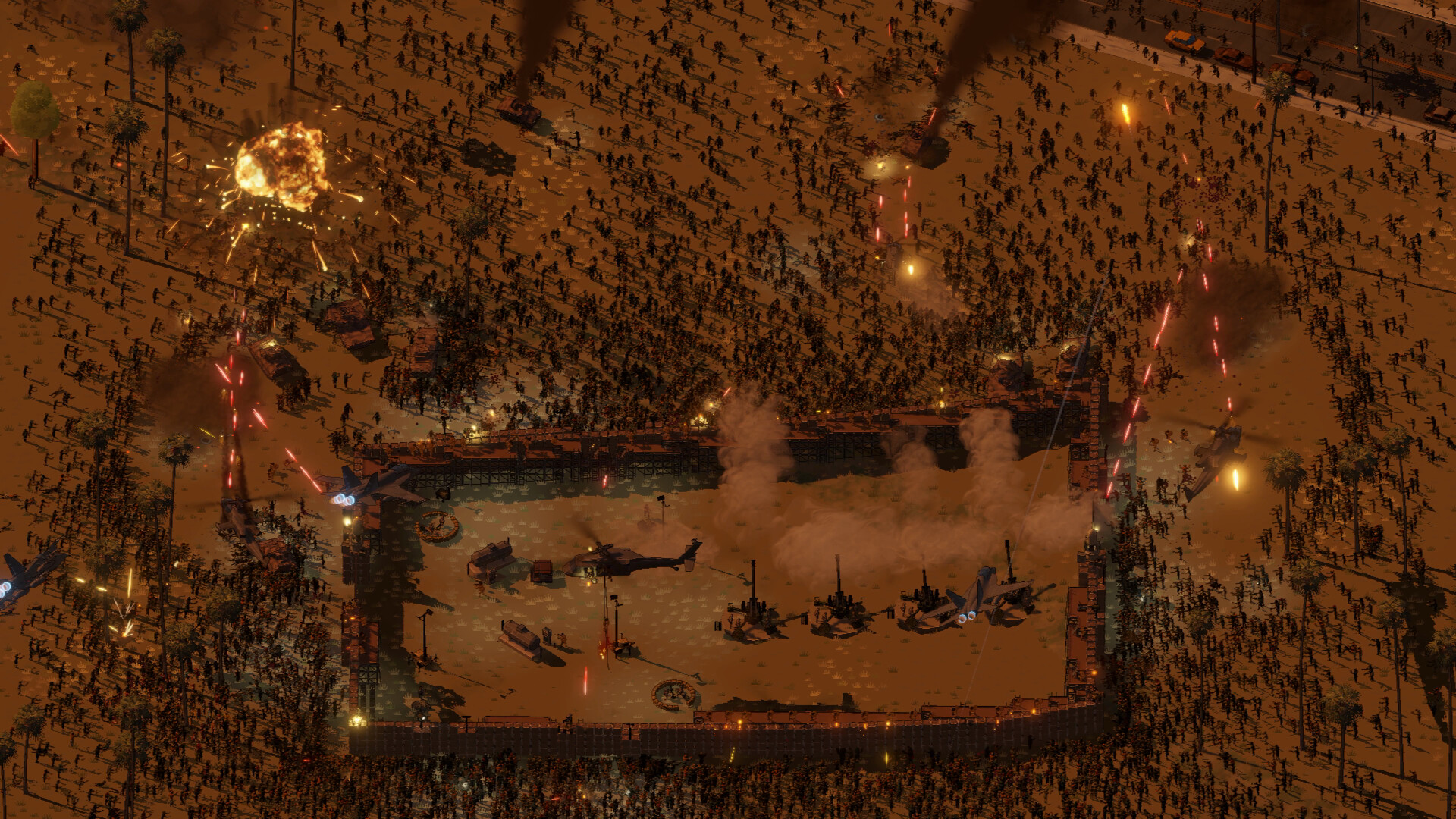
Surviving against the infected requires a complete shift in how you view standard defensive lines. The undead in this title do not simply shamble into your barricades; they interact dynamically with vertical space. Hordes can physically pile on top of one another to scale high walls, flood rooftops, and even reach for low-hovering support helicopters.
Furthermore, any human soldier who falls in combat against the infected does not stay dead—they rise swiftly to reinforce the enemy ranks. This terrifying snowball effect means that a single breached checkpoint can quickly cascade into a total territorial collapse if you fail to apply immediate firepower.
| Enemy Behavior | Tactical Threat | Countermeasure |
|---|---|---|
| Vertical Scaling | Undead pile up to climb walls and building ledges | Build elevated scaffolding, position short-range gun nests |
| Chopper Ambush | Hordes cling to low-flying aircraft | Maintain altitude awareness; escort with ground suppression |
| Infection Conversion | Fallen soldiers immediately join the horde | Prioritize casualty extraction or targeted incineration |
Deploying Heavy Firepower and Logistics
When standard infantry and armored vehicles like the M2 Abrams tank are not enough to stem the tide, you have access to a devastating array of heavy support assets. However, military might always comes with a logistical cost. Ship magazines are strictly finite, and heavy artillery barrages will level surrounding city blocks, potentially destroying the very infrastructure you are trying to protect.
According to official game updates detailed on the Ebbtide Steam Store Page, your tactical toolkit includes everything from ground-based artillery to naval support and air dominance:
- Artillery & Missiles: M777 howitzers, HIMARS rocket systems, and naval destroyer guns paired with Tomahawk cruise missiles.
- Air Support: Carrier-based F/A-18s, Air Force F-15Es, F-35Bs, A-10 Thunderbolt II strafing runs, and persistent AC-130J gunship orbits.
- Recon & Oversight: MQ-9 Reaper drone orbits to maintain vital lines of sight across dense urban environments.
Base building is equally critical for long-term survival. You must establish forward operating bases by hauling in heavy materials via hooklift trucks or helicopter slings. Raising HESCO barriers, concrete walls, ammo depots, and fuel points keeps your mechanized units operational. Because vehicles and aircraft continuously burn through fuel and ammunition, keeping your supply roads clear of roaming hordes is an ongoing logistical nightmare.
| Support Category | Specific Assets | Primary Tactical Use | Logistical Constraint |
|---|---|---|---|
| Artillery | M777, HIMARS | Long-range area denial and horde dispersion | High ammunition consumption, collateral damage |
| Naval Strike | Destroyer Guns, Tomahawks | Heavy structural demolition near coastal zones | Finite ship magazines and missile payloads |
| Fixed-Wing Air | F/A-18, F-35B, A-10 | Rapid response strikes on massive horde clusters | Fuel limits and turnaround times at the carrier |
| Loitering Support | AC-130J, MQ-9 Drones | Continuous fire support and intelligence gathering | Vulnerable to prolonged operational exposure |
Expanding from Local Defense to a Global Campaign
Holding Los Angeles is only the opening chapter of your journey. The personnel, surviving specialists, equipment, and supplies you manage to secure at the Port of LA form your core expeditionary force aboard the flagship Ark.
Once your carrier group hits the open ocean, the campaign scales globally. You can choose which international regions to support, bring your fleet’s massive guns and aircraft within striking distance of coastal hotspots, and resupply at friendly ports. Along the way, you must rescue rare pilots and civilian specialists who cannot be trained conventionally, grow your fleet with allied warships, and ultimately hunt down the hidden command nodes of the enigmatic Nexus faction to save what remains of human civilization.
Frequently Asked Questions
What is the primary objective in Ebbtide?
The main goal is to command humanity’s last carrier task force (TF-1 “Ark”), starting with a desperate defensive campaign to hold Los Angeles before expanding into a global war to hunt down the hidden command nodes of the Nexus.
How does base building work in the game?
Players must select strategic locations to construct forward operating bases using HESCO walls, gates, gun nests, and resource depots. Because all units require ammunition and fuel, maintaining open supply lines via trucks and helicopters is essential for survival.
Are there separate loading screens between the strategic map and tactical combat?
No. The game features a seamless zooming interface. You can scroll from the overarching operational map directly down into individual city streets to fight in real time without any loading screens or hidden auto-resolve mechanics.
What are the system requirements for playing?
At a minimum, the game requires a 64-bit processor and operating system running Windows 10 (or compatible Apple Silicon for macOS) with DirectX 11 and about 10 GB of available storage space. Final detailed system specifications are announced closer to launch.